Solution Architecture
Sandbox Studio solution is built entirely on AWS services, with each component playing a specific role in delivering, securing, and managing sandbox environments. The architecture uses managed services to ensure scalability, security, and automation.
The diagram below shows the main components and how they interact. Follow the numbered sections in this guide to understand the purpose and function of each component in the solution.
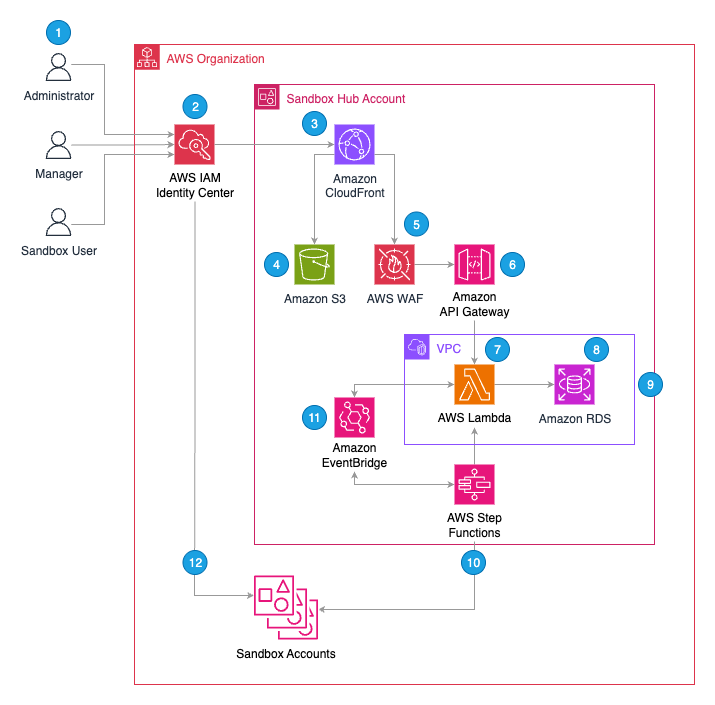
1. User Roles & Responsibilities
Sandbox Studio supports three types of users, each with distinct responsibilities:
1. Administrators
Responsible for configuring and maintaining Sandbox Studio for their organisation.
Key responsibilities include:
-
Setting global policies such as maximum budget thresholds and cleanup rules.
-
Managing AWS integration, including permissions and guardrails.
-
Provisioning new sandbox accounts when needed.
-
Overseeing security and governance settings.
2. Managers
Oversee day-to-day sandbox usage within a team or department.
Key responsibilities include:
-
Approving or rejecting sandbox requests.
-
Assigning account templates to users.
-
Tracking spending and activity for accounts under their supervision.
3. Sandbox Users
Request and use sandbox accounts for development, testing, training, or experimentation.
They must operate within:
-
Guardrails
-
Permissions
-
Budget limits
2. Authentication and Access
-
All users access Sandbox Studio via a SAML 2.0 application using AWS IAM Identity Center.
-
IAM Identity Center can:
-
Use its own internal user store, or
-
Integrate with external identity providers (e.g., Okta, Microsoft Entra ID).
-
-
Most organisations with an existing AWS Organisation use an external provider for centralised identity management.
3. Application Entry Point
-
The web UI is accessed through Amazon CloudFront, which serves as a single entry point for:
-
The static web UI (hosted in Amazon S3).
-
API endpoints (via Amazon API Gateway).
-
4. UI Hosting
-
Amazon S3 hosts static assets such as HTML, CSS, and JavaScript files.
5. API Protection
-
AWS WAF protects API Gateway from common exploits, bots, and resource abuse.
6. API Gateway
-
The web UI communicates with Amazon API Gateway REST APIs to:
-
Fetch data
-
Update configuration and status information
-
-
AWS Lambda functions authorize requests using role-based access control based on IAM Identity Center groups.
7. Backend
AWS Lambda is used throughout Sandbox Studio to run backend logic, including:
8. Database
-
AWS Lambda functions read and write configuration and status data to a PostgreSQL database deployed using Amazon Relational Database Service (RDS).
-
The RDS database runs inside a VPC in the sandbox hub account.
9. Networking
The Amazon Virtual Private Cloud (VPC) hosts the PostgreSQL RDS database used by Sandbox Studio.
Key characteristics include:
-
Private subnets for hosting the RDS database securely.
-
VPC-enabled Lambda functions to allow direct database access.
-
Network isolation from other AWS resources to protect sensitive configuration and status data.
10. Account Lifecycle Management
- AWS Step Functions coordinate the lifecycle of sandbox accounts, including:
- Onboarding new accounts
- Terminating leases
- Cleaning up accounts for reuse
- Step Functions move accounts between Organizational Units (OUs) based on their current status.
- Onboarding or termination events trigger dedicated cleanup workflows. These workflows can invoke other AWS services, such as AWS CodeBuild, to run resource deletion tools like AWS Nuke, ensuring all user-created resources are removed before the account is returned to the available pool.
11. Event-Driven Automation
-
Amazon EventBridge routes lifecycle events such as
-
Lease budget breaches
-
Lease duration breaches
-
-
When triggered, these events can:
-
Send email notifications
-
Invoke Lambda functions and Step Functions to manage lifecycle actions
-
12. Sandbox Account Access
-
Users can access assigned AWS sandbox accounts via:
-
AWS IAM Identity Center Access Portal (console access)
-
Programmatic access using generated credentials
-
-
The Sandbox Studio web UI provides SSO links for direct AWS console login.
13. Licensing Server
-
Sandbox Studio regularly queries the Sandbox Studio Software Licensing Service to confirm the customer's entitlement. That service will also query the AWS Marketplace.
Note: a number of other supporting AWS services are used by Sandbox Studio. Please see AWS services in this solution for the full list.